The Two-Crore Interval: A Story Every Founder — and Every Employee With ESOPs — Has Lived
A founder I know received ₹2 Cr from a secondary sale. He had no financial plan. Six months later, half of it was effectively gone — not from bad investments, but from no investments at all.
PERSONAL FINANCE
My post content
Act I — The Illusion of Triumph
There is a particular kind of silence that follows a great victory. Not the silence of emptiness — the silence of disbelief. The silence of a person standing at the summit, looking down at the path they climbed, and for one suspended moment, not quite believing it was their feet that carried them here.
This is that story. And it belongs to more people than you might think.
Scene one. He is at his desk. The same desk where, for years, he fought — with vendors, with investors, with his own doubts at 2 AM. The hustle that defined his every waking hour has, for this one moment, gone quiet. The secondary sale — the one his lawyers negotiated for months — has finally closed.
A notification pings. ₹2,00,00,000. Two crore rupees. Not on a cap table. Not in a valuation deck. Real money, sitting in his personal account.
Scene two. Cut to a different city. A different desk. A woman who joined a fintech startup nine years ago — back when the office was two rooms and the coffee was instant. She stayed through three pivots, two near-death funding rounds, and the kind of years that don’t show up on a resume but show up everywhere else.
Her company went public this year. The ESOP unlock notification arrives on her phone on a Tuesday afternoon, between meetings. ₹45,00,000. More money than she has ever held at once, in her life.
Both of them, in this moment, feel the same thing. The years of deferred salary. The family functions missed. The flights not taken because the runway, or the deadline, mattered more. All of it — vindicated, in a single notification.
They have built something real. The world has paid them for it. They think — and who could blame them — I have won.
This is the moment every film would end on.
The swelling music.
The triumphant close-up.
The End.
But life, unlike cinema, does not roll credits when the money lands. Life simply... continues. And it is in that continuation — in the quiet, unremarkable days that follow the triumph — that the real story begins.
Act II — The Silent Thief
Here is what did not happen to our founder.
He did not buy a car he couldn’t justify. He did not make a reckless bet on a hot stock tip from a college friend. He did not lose the money to a scam, a fraud, or a bad investment of any kind.
In fact — and this is important — he did something that felt, to him, like the responsible thing. The careful thing. The thing a sensible person does with money they cannot afford to lose.
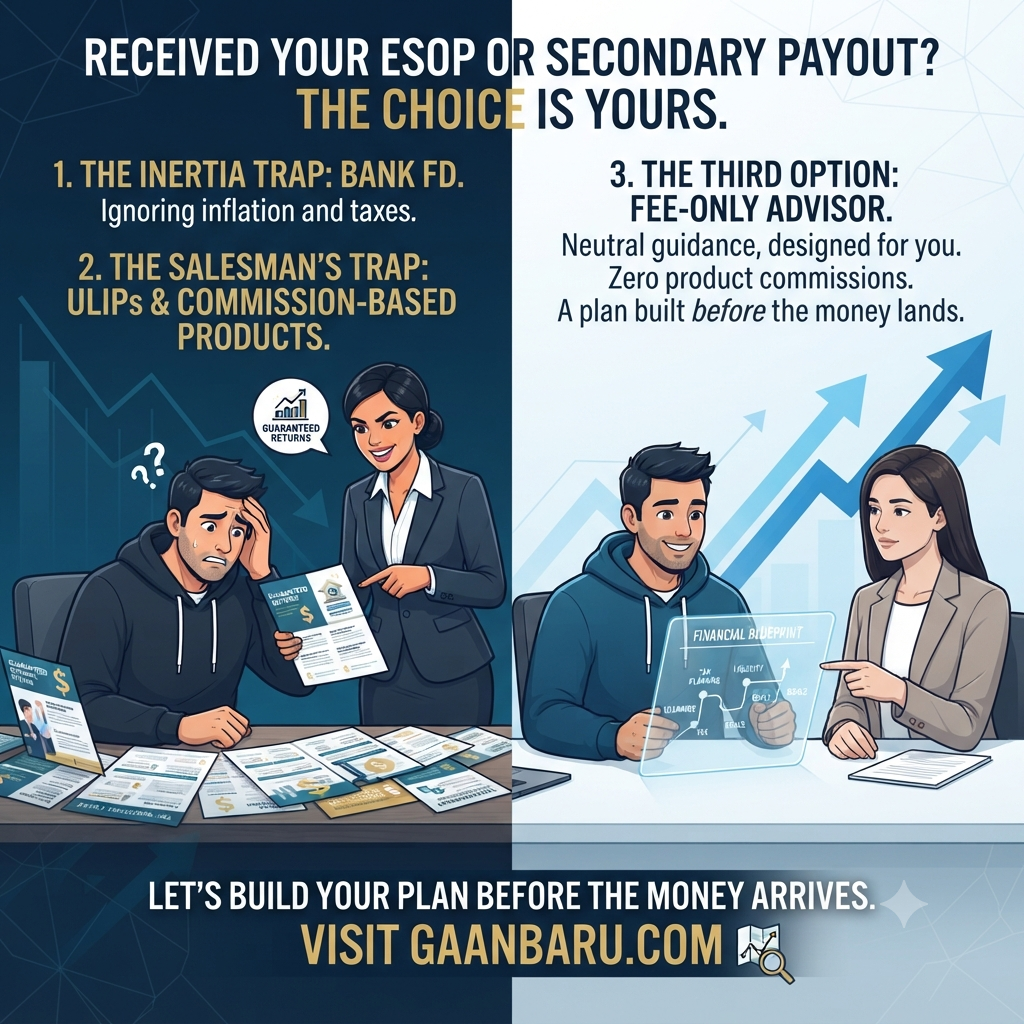
He walked into his bank and put the entire ₹2 crore into a fixed deposit.
“Why pay someone 1-2% a year to manage my money,” he reasoned, “when the bank will pay ME 5.5%, guaranteed, with zero risk? I built a company. I don’t need to pay for advice. I need to not be foolish with this money.”
It is, on its face, a reasonable thought. It is also, almost word for word, the thought that quietly cost him a crore.
Because here is the arithmetic nobody showed him. That 5.5% from the FD is not 5.5% to him. He is in the highest tax bracket — the same bracket his accountant has spent years optimising his company’s structure to manage efficiently. On FD interest, there is no such optimisation. It is taxed, in full, at his slab rate — over 30%, before cess and surcharge.
5.5%, taxed at roughly 35.88% effective, becomes a post-tax return of approximately 3.6%.
And inflation — the same quiet 6% that erodes every rupee in this country, every single day, without sending a single notification — does not pause to acknowledge that he was being careful.
3.6% earned. 6% eroded. The gap is small enough, day to day, that it is invisible. And large enough, over six months, that Aadhi reh gayi — half of it, in real terms, simply walked away. Not stolen. Not spent. Not even mismanaged, in the way most people understand that word.
Lost to the one risk he never priced in: the risk of being careful in the wrong way.
Now — the part of the story that almost everyone in this position experiences, and almost no one talks about.
The moment ₹2 crore lands in an account — any account, anywhere — something else happens almost simultaneously.
The phone starts ringing.
Not from friends. From the bank itself. A “wealth relationship manager” — someone the founder has never spoken to in nine years of having an account at this bank — suddenly has his direct number, and a great deal of warmth in their voice.
“Sir, congratulations on the transaction. Given your profile, I’d love to walk you through some exclusive opportunities we have right now — there’s a new fund launch closing this week, really excellent early numbers...”
Across the city, our second protagonist — the employee with her ₹45 lakh — receives a similar call. She is less experienced with this kind of money, and the relationship manager senses it. Within two weeks, on the strength of one persuasive meeting and a glossy brochure, she has signed up for a ULIP — a unit-linked insurance plan, sold to her as “the smart way to invest and get insurance cover in one product.”
What she does not see — what is never explained in the meeting — is the structure beneath the brochure. A significant premium allocation charge in the early years. Mortality charges embedded for insurance she likely already has, more cheaply, elsewhere. A five-year lock-in. And — this is the part that matters most — a healthy commission, paid by the insurer to the relationship manager and the bank, the moment she signs.
The product is not illegal. It is not even unusual. It is simply not for her. But the person who sold it to her had every incentive to sell it, and no obligation whatsoever to tell her that.
This is not a story of villains. The relationship managers are not bad people — they are doing their jobs, in a system explicitly designed to reward them for selling, not for advising.
But our founder, watching this circus from a slight distance — having politely declined three “exclusive opportunities” in as many weeks — draws the wrong lesson from it. “This is exactly why I don’t deal with these people. I’ll just keep it in the FD. At least nobody’s selling me anything.”
He is right to distrust the salesman. He is wrong to conclude that the only alternative to a salesman is no advice at all.
There is a third option. He has simply never been told it exists.
Act III — The Wave That Lifted a Nation, and the Tide That No One Watched
But here is what makes this story matter beyond two people, two notifications, two very different mistakes with the same root cause.
Neither of them is alone.
For years, Indian startups built something extraordinary — and for years, that something existed mostly as paper. ESOPs. Equity grants. Beautifully designed cap table slides. Wealth that was real in theory, and entirely theoretical in practice. A mirage in the desert — shimmering, vast, and just out of reach, no matter how far you walked toward it.
And then — slowly, and then suddenly — the mirage began to turn into water.
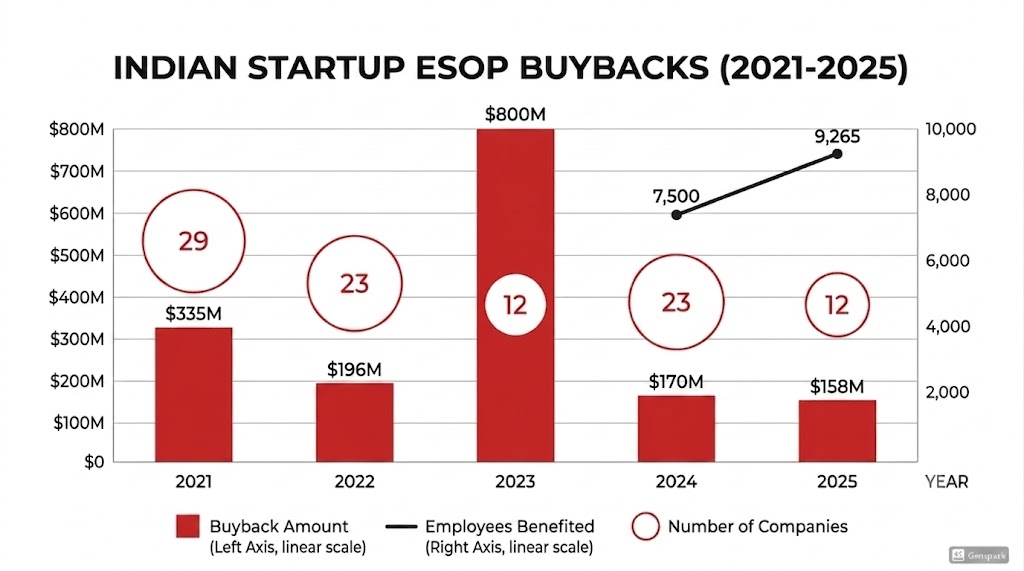
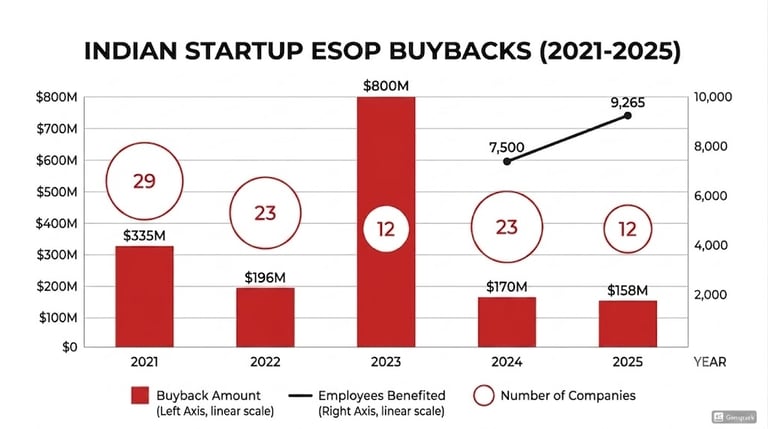
In 2024, this transformation was already well underway. Twenty-three startups ran ESOP buyback programmes. Over 3,000 employees — people just like our second protagonist — cashed out. More than ₹1,450 crore, roughly $170 million, moved from paper into bank accounts.
Swiggy alone delivered $65 million to its people. Urban Company returned ₹203 crore to 446 employees. Meesho, Capillary, OfBusiness — name after name, each one a moment where years of belief turned, finally, into rupees someone could touch
And then came 2025.
If 2024 was the gathering of the wave, 2025 was the wave breaking on the shore — and the ecosystem would come to call it, simply, the Year of IPOs.
Sixteen startups went public in 2025 — compared to ten the year before, and just four the year before that. And with those sixteen listings came a number that demanded a pause: one billion dollars — over ₹8,000 crore — unlocked in employee wealth through public markets in a single year.
Groww’s 1,415 employees saw approximately ₹2,500 crore unlock. PhonePe returned ₹800 crore to a thousand of its people ahead of its own listing. Swiggy’s leadership crossed ₹2,240 crore through ESOPs granted before listing. Flipkart handed $50 million in liquidity to 7,500 employees.
For sixteen companies and tens of thousands of employees — engineers, designers, customer support leads, people at every level — the words “paper wealth” stopped being a hedge, and started being a historical description.
And yet.
Even in this year of triumphant IPOs, twelve separate startups quietly ran their own ESOP buyback programmes. ₹1,409 crore. Over $158 million. More than 9,200 employees — each one, in their own way, living the opening scene of our story.
Ten thousand people. In one year. Each one receiving a notification. Each one facing, in the days that followed, the same fork in the road: the FD that quietly loses to inflation and tax, or the relationship manager’s call that arrives within the week.
Almost none of them were told that a third path exists.
Act IV — The Blueprint That Should Have Existed Before the Music Started
Every great heist film has one thing in common: the plan exists before the vault is opened. By the time the door swings open, every step has already been rehearsed.
A liquidity event — whether ₹2 crore from a secondary sale or ₹45 lakh from an ESOP unlock — deserves the same discipline. Here is the blueprint. Three steps.
Step 1: Define the Liquidity Timeline — Before the Money Arrives
The first question is not “FD or mutual fund?” The first question is: what is this money for, and on what timeline?
Some of it has a near-term job — taxes, a planned expense, the beginning of a different kind of life. That portion should be liquid and safe, full stop — an FD is not wrong for this slice. The mistake is not the FD. The mistake is putting the entire amount there, as if the whole sum had only one job, when in reality most of it has no near-term claim at all, and an entirely different job: to grow, deliberately, faster than inflation, for decades.
Step 2: Escape Both Traps — The Inertia Trap, and the Salesman’s Trap
The inertia trap is the FD-for-everything decision — mistaking “safe-feeling” for “safe,” and discovering only in hindsight that 5.5% pre-tax was never 5.5% at all.
The salesman’s trap is the opposite failure with the same cause: mistaking a call from a bank for advice, when it is, structurally, a sales pitch — one where the product recommended is frequently the one that pays the recommender the most, not the one that serves the client best.
Escaping both traps requires the same thing: a framework, built once, for how this money will be allocated across time horizons, asset classes, and tax structures — built by someone with no product to sell.
Step 3: Hire a Fee-Only Advisor — Before the Transaction Closes, Not After
This is the step that would have changed both of our protagonists’ stories.
A fee-only investment advisor — a SEBI-Registered Investment Advisor who charges a transparent fee for advice, and earns nothing from any mutual fund, insurer, or AMC, regardless of what is recommended — is structurally incapable of having the conflict of interest that sold our employee a ULIP she didn’t need.
Their advice is neutral by design — not because they are more virtuous than a bank’s relationship manager, but because the incentive that distorts the relationship manager’s advice simply does not exist in this model. They are paid the same amount whether the recommendation is an index fund, a debt fund, or — yes, sometimes — an FD for part of the portfolio. The recommendation follows the client’s interest, because there is nothing else for it to follow.
The highest-leverage moment to bring this person into the picture is not after the money lands — when the phone is already ringing, when the euphoria and exhaustion are already clouding judgement. It is before. While the secondary sale is still in negotiation. While the IPO is still being prepared.
A plan built before that moment means that when the notification pings — and when, inevitably, the first “exclusive opportunity” call arrives a few days later — there is already a neutral voice in the room. Not to say yes. Not to say no. Simply to ask, on the client’s behalf and no one else’s: does this serve the plan, or does it serve the person selling it?
That single question, asked by someone with no stake in the answer, is the entire difference between the story we opened with, and the story that doesn’t need to be told at all.
The Poetic Climax
Yeh kahaani sirf paison ki nahi hai. This story is not, in the end, about money.
A liquidity event without a plan is not a tragedy of greed, or carelessness, or bad luck. It is something quieter, and in its way sadder: a lifetime of opportunity, arriving all at once, and being allowed to simply pass by — not stolen in any single dramatic moment, but eroded by a tax rate no one mentioned, a fund no one needed, and an inflation rate that never once announced itself.
Ten thousand people lived this opening scene in 2025 alone — founders and the employees who built alongside them, in equal measure. Sixteen companies rang the bell. ₹8,000 crore and more crossed from paper into possibility.
The story of what happens next, for each of them, has not yet been written.
For some, it will be a story of compounding — of a plan, built quietly, with a neutral voice in the room, before the notification ever arrived.
For others, it will be the story we opened with. The notification. The silence. The FD that felt safe. The call that felt like advice. And six months later, without a single dramatic mistake ever having been made — aadhi reh gayi.
The choice between these two stories is made, almost always, in the quiet weeks before the money arrives — not after.
If you are expecting a liquidity event in the next 12 months, let’s build your plan before the money arrives.
Not After.
→ Build your liquidity plan now: www.gaanbaru.com
Warning: Investment in securities market are subject to market risks. Read all the related documents carefully before investing. Registration granted by SEBI, membership of BSE Enlistment No and certification from National Institute of Securities Markets (NISM) in no way guarantee performance of the intermediary or provide any assurance of returns to investors.
Aditya Jadhav CFA
Tradename: GaanBaru
Registration Type: Individual
Registration: INA000022729
Validity: Jun 04, 2026 till Perpetual
BSE Enlistment No: 2510
Principal Officer: Aditya Jadhav CFA
Email: aditya@gaanbaru.com
Contact: 09967013381
Regulatory License:
Aditya Jadhav – Investment Adviser
INA000022729
Contact
Phone
Registered Office
43 Golden Bamboo, Orchids, Majiwade, Thane (W), 400601
SEBI regional/local address:
SEBI Bhavan BKC , Plot No.C4-A, ‘G’ Block Bandra-Kurla Complex, Bandra (East), Mumbai – 400051, Maharashtra
Investor Grievances: