I left a VC career to build this...
India’s ambition to become a true startup nation will not be built on term sheets alone. It will not be built on unicorn valuations, on DPIIT registrations, or on the next generation of accelerator programmes. It will be built — or it will fail to be built — on the strength of the foundations that sit beneath all of those things. Not the VC ecosystem. The family around the founder.
ENTREPRENEURSHIPPERSONAL FINANCE
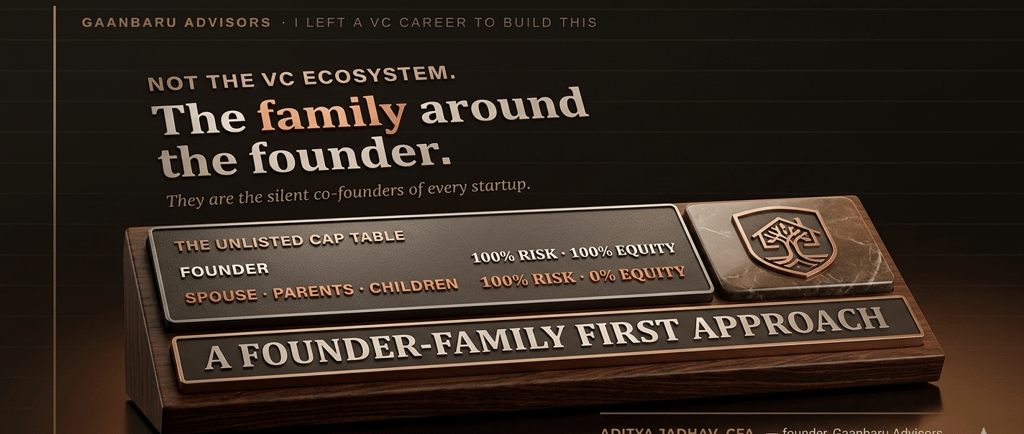
I’ve been in the room when term sheets were signed for ₹50 Crore rounds. I watched brilliant founders celebrate. Then I watched the same founders struggle financially 3 years later. That is why GaanBaru exists.
We stand today at a historic moment of economic transformation. We look upon a landscape where the entrepreneurial spirit of India has risen like a mighty wave, with over 2.23 lakh officially recognized startups breathing life into our nation’s dreams. We celebrate the creation of over 23.36 lakh direct jobs, a testament to the hard work of our youth. But let us not be blinded by the dazzling light of these massive numbers. Let us not mistake the roar of the crowd for the strength of the foundation.
We are watching our bravest minds enter a wilderness of survival, where 85% to 90% of seed-stage startups fail to cross the rugged chasm into a Series A round.
For beneath the surface of this grand expansion lies a quiet, bleeding tragedy. We are witnessing a punishing recalibration, where technology startup funding has declined by 18% to $11.7 billion. In this climate of transition, our founders are marching through the jagged valleys of funding winters, unequipped and unhedged.
Indian Startup Ecosystem Dynamics and Funding Realities
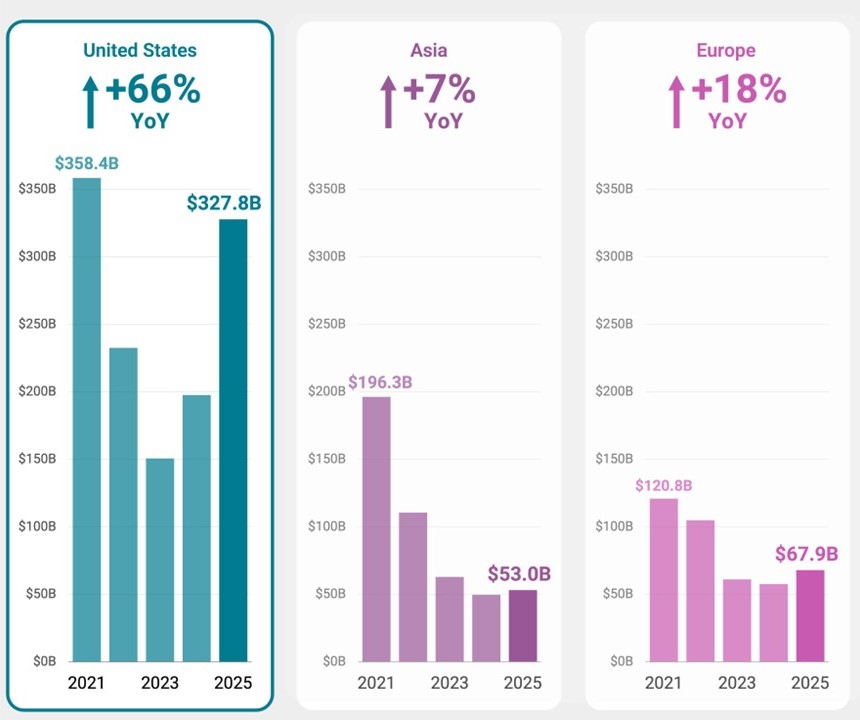
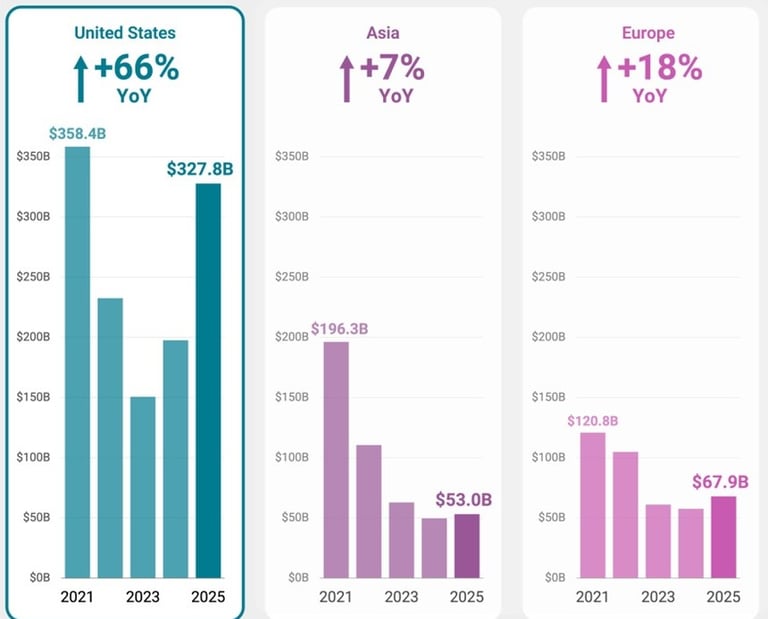
The 2025 fundraising landscape is defined by a massive resurgence in total capital, with global venture funding rising 47% to $469 billion and US startups capturing 70% of that total capital. This recovery is driven by a high concentration of capital in mega-rounds, particularly within the AI sector, which secured a record 48% of all venture dollars and was skewed by historic multi-billion-dollar rounds for companies like OpenAI and Anthropic.
Mega-rounds (deals of $100 million or more) accounted for 65% of total global funding in 2025. Global mega-round funding nearly doubled, rising from $166.2 billion in 2024 to $307.2 billion in 2025. While total investment has surged, the overall deal count has fallen 17%, indicating that investors are making larger, more selective bets on a smaller number of “winner-take-all” companies. Valuations are climbing across nearly all stages—with seed-stage valuations reaching record highs—even as the time required for startups to graduate from one funding round to the next continues to elongate.
Source: CB Insights
Annual Venture Funding per region
In 2025, India’s venture capital landscape demonstrated steady stabilization and a resurgence in high-value activity following the "funding winter" of previous years. The year was marked by a return to billion-dollar quarterly funding levels and a robust exit environment. One of the most significant developments in 2025 was India’s emergence as a global leader in startup exits. In the final quarter of 2025, India claimed several of the world’s top IPOs, highlighting a maturing ecosystem where companies are reaching public market readiness.
However, in India AI accounts for 84% of DeepTech start-ups and 91% of DeepTech funding, underscoring its dominance as the primary capital magnet within Indiaʼs frontier ecosystem. DeepTech investment remained active in 2025, with Seed and Early-stage companies accounting for ~35% of total tech funding. In line with 2024 levels, this signals sustained entry-stage participation even within a more selective capital environment.
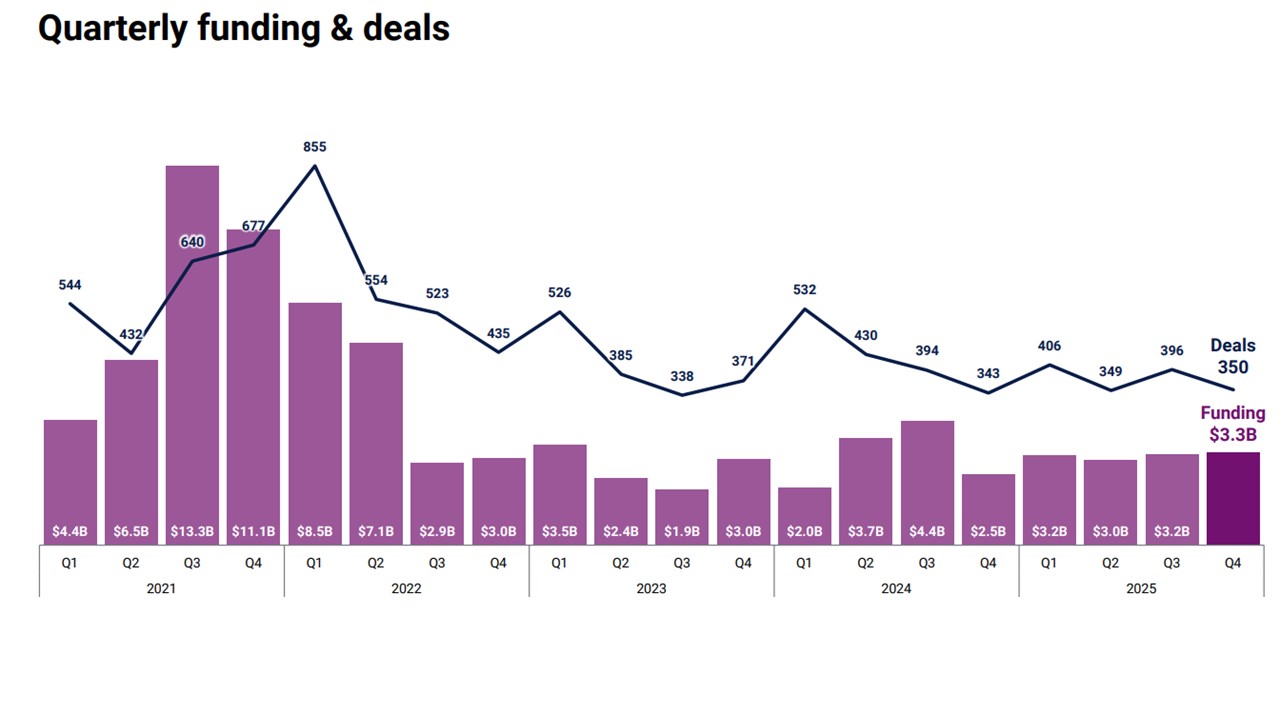
Quarterly Venture Funding in India Source: CB Insights
The Anatomy of a Startup Graveyard
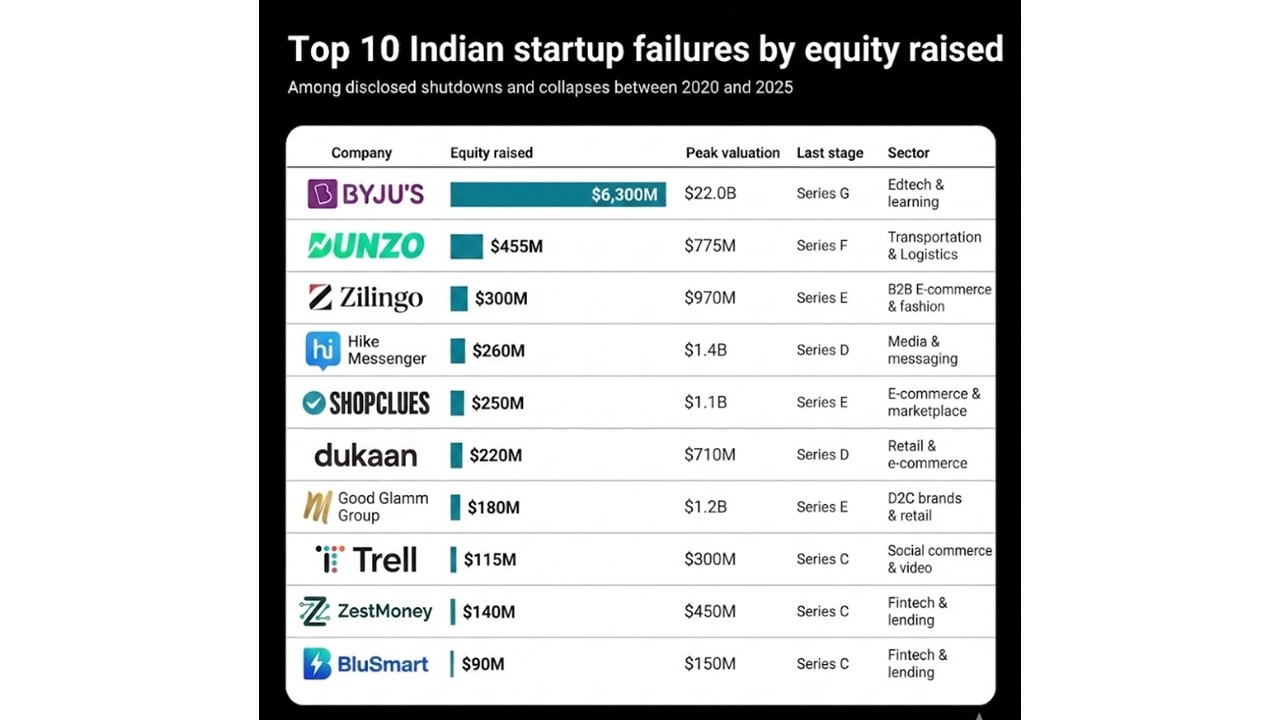
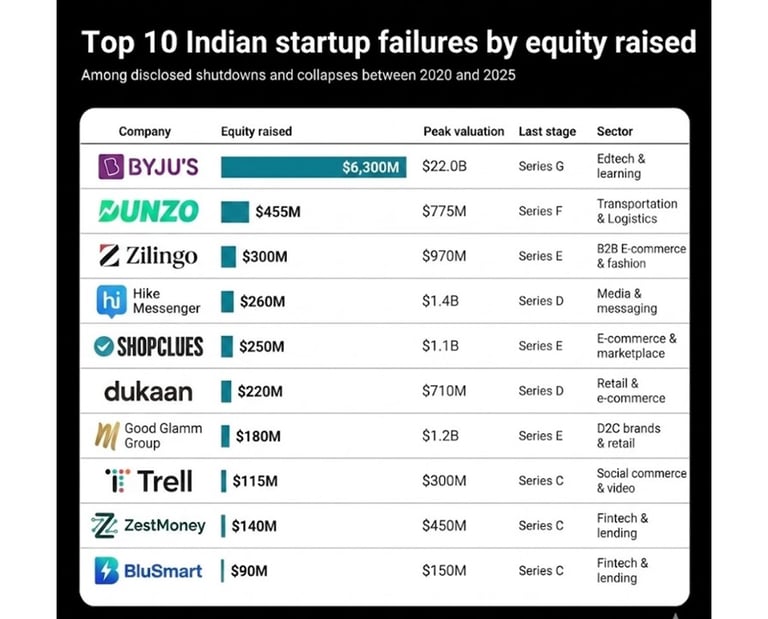
Startup failures are rarely caused by a single issue, though “running out of capital” is the most common final indicator, occurring in 70% of cases. This is typically a symptom of underlying problems, such as poor product-market fit, which affects 43% of failing startups, as well as bad timing (29%) and unsustainable unit economics (19%). While early-stage ventures often struggle to find a market, later-stage companies frequently fail as well because early traction fails to scale into a sustainable business. All Indian startups mentioned here had raised capital ranging from $100 million to $6.3 billion, before shutting down.
Beyond business model failures, governance and regulatory issues are critical drivers of collapse in India.
Byju’s: Once valued at $22 billion, the firm collapsed due to revenue inflation, aggressive sales, and regulatory violations (FEMA).
BluSmart: Collapsed in 2025 following a Rs 260 crore scandal involving fabricated documents and the misappropriation of funds.
Zilingo: The fashion-tech platform failed in 2023 after audits uncovered revenue manipulation.
Trell: Shutdown in 2022 due to the alleged diversion of company funds for personal use.
While founders cite a range of causes in shutdown post-mortems, there are enough predictive indicators that show measurable deterioration in company health and activity in the months leading up to shutdown.
Looking at historical data on company failures, roughly 2/3 of companies with available headcount data were already shrinking in the six months leading up to their shutdown. Close to a 1/3 folded with 10 or fewer employees still on staff, while around 15% died as larger organisations with more than 100 employees.
Zombie Stage of Startup
The median time from last fundraise to death is 22 months across the globe. In other words, over half of the VC backed companies died within 2 years of their last raise. However, nearly a quarter of startups had been “walking dead” for over 3 years since their last raise before officially going under.
Currently, globally, there are nearly 50,000 VC-backed startups that haven’t raised funding since the start of 2023.
Across early and mid-stage financing, there is a clear trend of elongation, with the median time from Seed to Series A rising from 1.4 years in 2017 to 2.1 years in 2025, while the intervals for Series A to Series B and Series B to Series C have both extended to a median of 2.6 years. This suggests that founders must now plan for longer operational runways to secure subsequent capital.
Conversely, the dynamics appear to stabilize or compress in later stages, as the median timelines for Series C to Series D and Series D to Series E showed a reduction in 2025 compared to 2024 peaks, resting at 2.1 years and 1.7 years respectively. Overall, this environment points to a more cautious deployment of capital that rewards maturity and proven business stability over the rapid, early-stage scaling models observed in previous years.
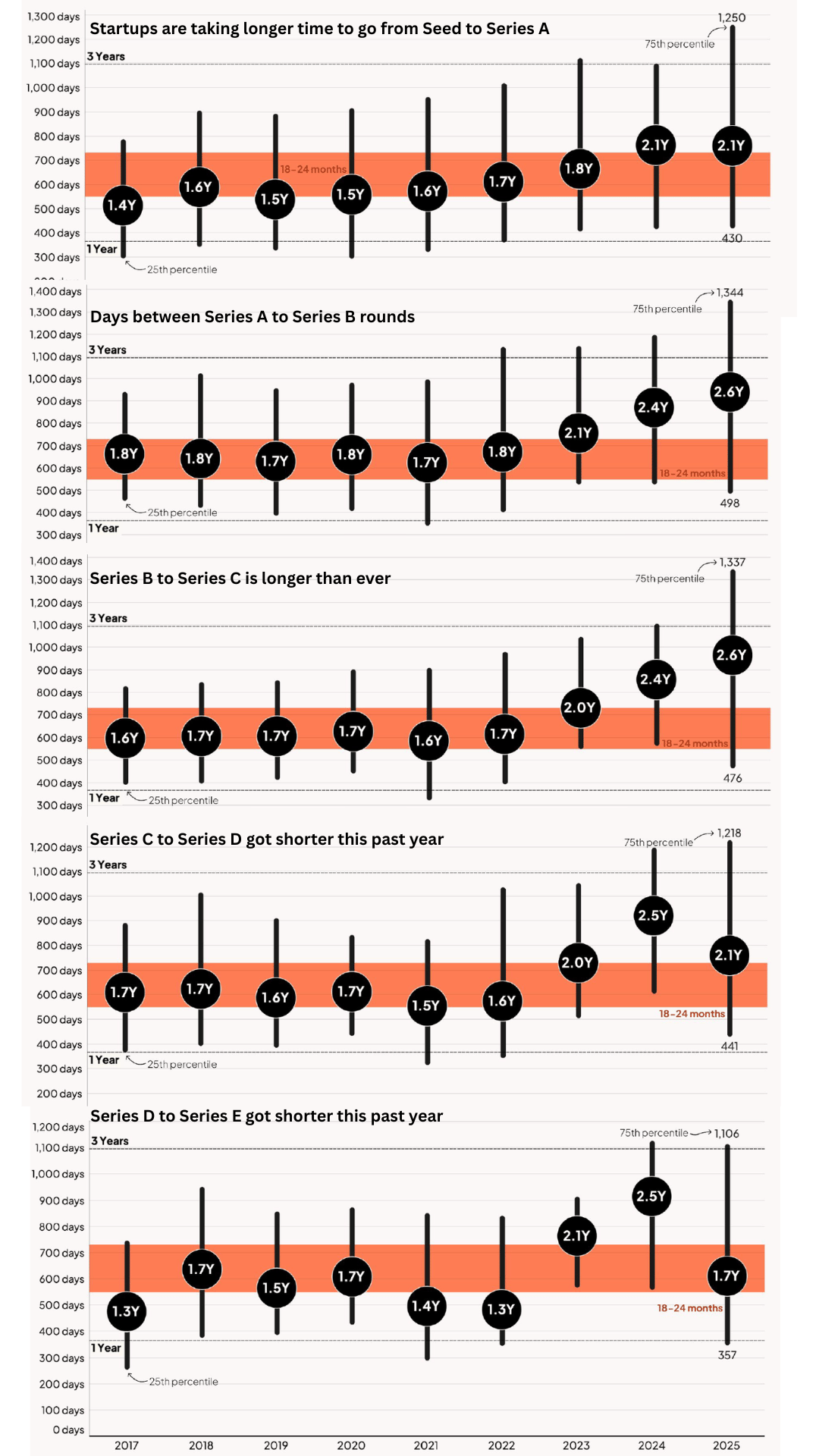
Time between Existing and Next Round of Funding.
Source: Carta, Circle= median years
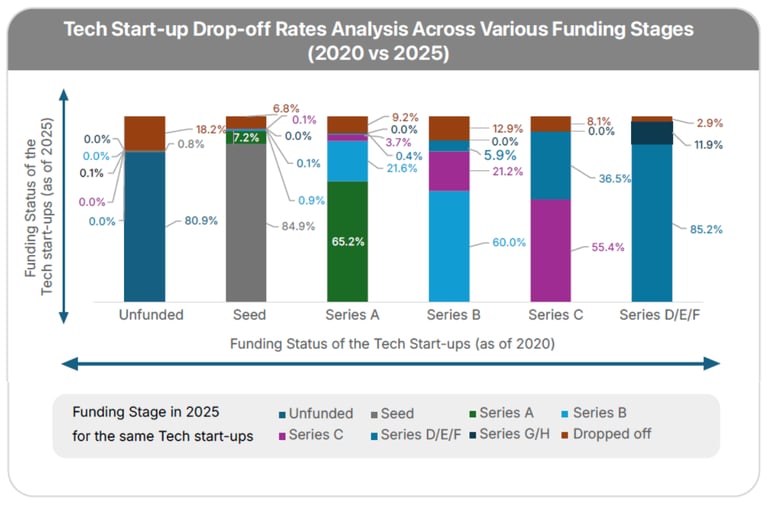
The startup landscape is currently defined by a phenomenon of "persistent stagnation" rather than immediate collapse. While the conventional narrative focuses on startup "failures," the data reveals a more nuanced reality.
Roughly 80–85% of tech startups in India remain at the same funding stage five years after their inception, struggling to cross the threshold between early-stage innovation and scalable commercialization.
The most critical bottleneck in this journey is the Seed-to-Series A transition. Often termed the "decisive commercial conversion stage," it is here that nearly 85% of startups fail to progress within a five-year window. While incubation programs are prevalent—often reaching 40–50% of startups—they primarily enhance pitch clarity and investor readiness without solving the fundamental hurdle: the ability to convert technology into repeatable go-to-market motions, pricing validation, and consistent revenue.
As a result, many startups find themselves in a “prolonged waiting zone” between Series A and Series B, where 60–65% of companies remain trapped due to a combination of delayed commercialization, cautious investor sentiment, and extended decision cycles. However, the data also offers a silver lining: stability increases significantly with maturity. While early-stage drop-off rates peak at approximately 18%, once a startup reaches Series C and beyond, structural stability improves and failure rates drop to below 10%.
For founders and investors alike, this underscores a vital lesson: building a “unicorn” is not just about the idea—it is about the rigorous, repeatable execution required to move from an early-stage concept to a validated, revenue-generating engine.
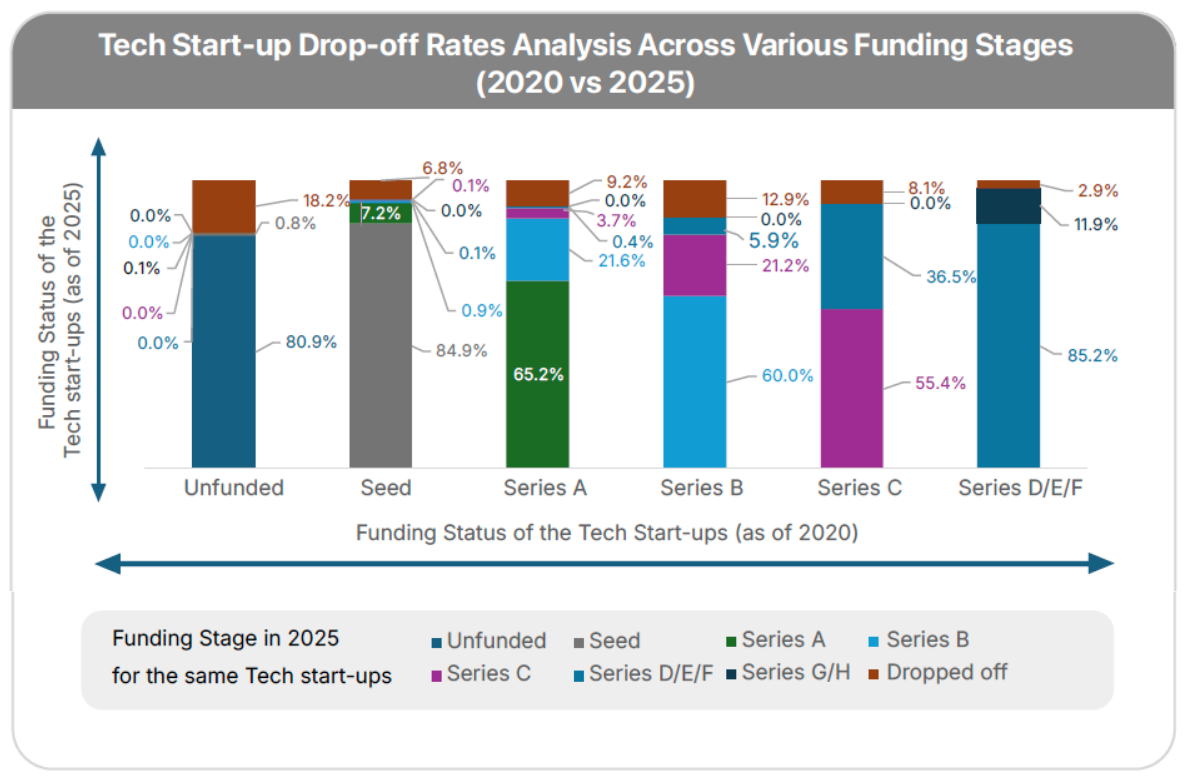
Source: NASSCOM
The Cobbler’s Children Have No Shoes
There is a peculiar irony that lives rent-free in the corner offices of India’s most celebrated founders. The same mind that can model a discounted cash flow across seventeen product lines, negotiate a ₹500-crore debt facility at 40 basis points below market, and restructure a subsidiary’s balance sheet over a Sunday afternoon — that same mind goes completely blank when asked:
“What is your personal net worth if your company valuation were to fall 60% tomorrow?”
The silence that follows is the most expensive silence in business.
I have sat across that silence more times than I can count — first as an investor, evaluating founders on behalf of VC funds, and later inside startups themselves, watching the machinery of company building from the inside. That combination of vantage points — the investor’s spreadsheet and the operator’s lived reality — is what makes the pattern impossible to unsee.
Because here is what the investor’s spreadsheet never fully captures: 85 to 90% of startups do not make it. This is not pessimism. This is the empirical reality of company building, documented across every market, every vintage, every geography. The odds are not a secret. Every founder knows them abstractly. And yet almost none prepare for them personally.
The ecosystem glamourises the 10% that survive. It writes case studies about them, profiles their founders on magazine covers, and dissects their cap tables at conferences. What it does not do — what it rarely does — is sit with the 90% after the lights go out.
I have. And I want to be honest with you: unless someone from your family or your closest circle has worked inside a startup that shut down, you cannot fully comprehend what that closure costs. It does not look like a press release. It does not look like a pivot announcement. It looks like a founder sitting in an apartment they can no longer afford, fielding calls from vendors they cannot pay, explaining to their parents why the dream they borrowed against their house to support has ended. It looks like a spouse returning to work not out of ambition but out of necessity. It looks like children who sense, without understanding, that something irreversible has shifted in their home.
When a startup closes, the obituary is written for the company. What goes unwritten is everything else.
The founder who spent eight years building — who deferred salary increments to extend runway, who pledged personal assets to secure a bridge loan, who skipped family holidays to close the next round — does not simply dust off their resume and move on. They return home to a family that absorbed every sacrifice, every weekend lost, every dinner eaten in distraction. And now, with the company gone, there is no valuation left to justify the cost of all that deferred living.
There is only the reckoning.
And it is not only founders who face this music. Hundreds of employees — talented, loyal people who believed enough in the vision to accept below-market salaries in exchange for ESOP grants — face the same collapse. Their equity, which they had quietly factored into their own family’s financial future, evaporates overnight. Unlike founders, they did not even have the psychological ownership of the dream. They simply trusted it. And that trust, when unprotected by personal financial planning, leaves them exposed in ways that take years to recover from.
This is the grim reality for which almost no one in the ecosystem is prepared. Not the founder. Not the team. Not the families who stood behind both.
It was that grim reality — not a business plan, not a market opportunity — that made me leave to build Gaanbaru Advisors. Not because the prior work wasn’t rewarding. It was. But because I kept watching the same tragedy unfold from both sides of the table: founders who had given everything to build something extraordinary, arriving at the other side of that journey — whether through exit, shutdown, or simple exhaustion — with far less personal financial security than they deserved.
The startup may not survive. The market may not cooperate. The next funding round may not close. These are risks that no advisor can eliminate. But the financial devastation that follows a startup’s closure — for the founder, for the team, for the families — that is a risk that can be meaningfully reduced. With liquidity reserves built in advance. With diversification harvested at every opportunity. With personal governance that runs parallel to, and independent of, the company’s fate.
And this brings me to something larger than any single founder’s balance sheet.
India’s ambition to become a true startup nation will not be built on term sheets alone. It will not be built on unicorn valuations, on DPIIT registrations, or on the next generation of accelerator programmes. It will be built — or it will fail to be built — on the strength of the foundations that sit beneath all of those things. Not the VC ecosystem.
The family around the founder.
If India is serious about building a generation of resilient, repeat entrepreneurs — founders who can take a failure in their stride, rebuild, and return to the arena — then the personal financial security of founder families cannot remain an afterthought. It must become infrastructure. As fundamental to the startup ecosystem as incubators, as angel networks, as regulatory sandboxes.
Gaanbaru was built for that silence — and for every family that deserves better than to be the uncounted casualty of a dream that didn’t make it.
Gaanbaru was built to be part of that infrastructure. Not as a financial product to be sold, but as a institution that becomes quietly, deeply embedded in the lives of founder families — the way a trusted family doctor is embedded, the way a trusted teacher is embedded. Present before the crisis. Useful through the journey. Steadying when the storm arrives.
Because India will produce the next generation of great companies. Of that, there is no doubt.
The question is whether the families who made those companies possible will be standing on solid ground when they do.
Gaanbaru exists to make sure the answer is yes.
If this felt familiar, it was written for you.
Book a 30-minute Founder Financial Health Check at GaanBaru.com — or send this to a founder who needs to read it.

Warning: Investment in securities market are subject to market risks. Read all the related documents carefully before investing. Registration granted by SEBI, membership of BSE Enlistment No and certification from National Institute of Securities Markets (NISM) in no way guarantee performance of the intermediary or provide any assurance of returns to investors.
Aditya Jadhav CFA
Tradename: GaanBaru
Registration Type: Individual
Registration: INA000022729
Validity: Jun 04, 2026 till Perpetual
BSE Enlistment No: 2510
Principal Officer: Aditya Jadhav CFA
Email: aditya@gaanbaru.com
Contact: 09967013381
Regulatory License:
Aditya Jadhav – Investment Adviser
INA000022729
Contact
Phone
Registered Office
43 Golden Bamboo, Orchids, Majiwade, Thane (W), 400601
SEBI regional/local address:
SEBI Bhavan BKC , Plot No.C4-A, ‘G’ Block Bandra-Kurla Complex, Bandra (East), Mumbai – 400051, Maharashtra
Investor Grievances: